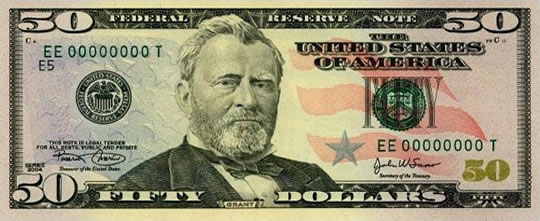
Ulysses
Simpson Grant was born April 26, 1822 in Point
Pleasant, Ohio. Against his father's wishes, Grant
entered the U.S. Military Academy and finished
in the middle of the class. Like most military
school graduates at the time, Grant was sent to
Mexico and served under General Zachary Taylor
during the Mexican War. In other endeavors before
the Civil War, Grant was unsuccessful.
At
the outbreak of the Civil War, Grant
was working at this father's leather shop in Illinois.
He was appointed by the Illinois Governor as the
commander of a local militia, but soon rose to
the rank of Brigadier General in the Civil War.
Grant's aggressive and bold tactics were a major
reason why the Union Army was able to defeat the
Confederates. His campaigns in the Mississippi
River valley were legendary and crucial to Union
victory. In 1862, Grant led his forces to victories
at Fort Henry and Fort Donelson in Tennessee. At
Fort Donelson, Grant earned the nickname "Unconditional
Surrender Grant". Though less successful at
Shiloh, Grant's leadership opened the way for Union
occupation of the Mississippi River. Grant went
on to to take the key port city of Vicksburg, and
then broke Confederate ranks at Chattanooga.
In
1864, President Lincoln named him General-in-Chief
of the Union army. Grant's "Overland Campaign"
at such battles as Wilderness, Cold Harbor and Petersburg
took a heavy toll on Lee's Army of Northern Virginia,
despite the heavy casualties inflicted upon his forces.
Lee's weakened forces held the Confederate strongholds
of Petersburg and Richmond for ten months before
being overwhelmed by Grant's forces. On April 9,
1865 Ulysses S. Grant received Lee's surrender and
the Civil War was over.
In
1869, Grant was elected president of the United
States. Unlike his military campaigns, his presidency
was less than successful and plagued by corruption.
Although he presided over Reconstruction in the
south, Grant was seen associating with prospectors
who tried to corner the market in gold. When he
realized their plan he authorized the Treasury
to sell enough gold to ruin the plan, but the damage
had already been done to business. After his presidency,
Grant joined a financial firm that ultimately went
bankrupt. In 1885, he died of throat cancer shortly
after writing his personal memoirs. His works ultimately
made $450,000 for his family. Grant is currently
honored on the 50 dollar bill of the United States. |