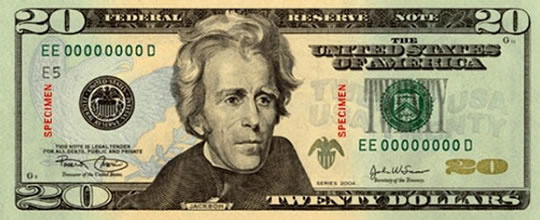
Andrew
Jackson was born in South Carolina on March
15th 1767.
He was the third son of Andrew and Elizabeth
Jackson, immigrants from
Northern Ireland
. Jackson’s father died days before he
was born.
As
a youngster, Jackson experienced no formal education
but spent several
years reading and studying law. At the age of 20
he was admitted to the bar. In 1788, he was
appointed public prosecutor of the western district
of North Carolina. He would soon settle in Nashville,
Tennessee and become a successful lawyer.
In
Tennessee, Jackson met
Rachel Donelson Robards who would eventually become
his wife. At the time Rachel was married to Captain
Lewis Robards, whose bad temper had driven Rachel
home to live with her mother who happened to be
Jackson’s
landlady. They were married in 1791. Jackson and
Rachel believed that Captain Robards had received
a legal divorce by the Virginia legislature, but
the marriage was not officially dissolved until
1793. This stunned the righteous Jackson and the
couple was properly remarried in 1794. Jackson’s
enemies would claim that he stole another’s
man wife and lived with her for 3 years. These
claims did not sit well with Jackson and often
invoked his famous temper. Jackson killed Charles
Dickinson, a fellow lawyer, in a pistol duel for
insulting Rachel. As Jackson continued to prosper
in Tennessee he built his famous mansion, the
Hermitage, near Nashville.
War
of 1812
Andrew
Jackson was commissioned as brigadier general and
then major general in the War of 1812. On November
7, 1814 Jackson drove the British from Florida
and captured the town of Pensacola. He became a
national hero when he defeated the British in The
Battle of New Orleans. The British sustained 2,000
dead and injured while Jackson sustained only 6
casualties. The Battle of New Orleans would be
the last battle of the war. On December 24, 1814
the Treaty of Ghent was signed which called for
the end of the war to take effect in February of
1815. Jackson would next drive the Seminole Indians
from Florida in 1818.
Controversy
On
March 4, 1823, Andrew Jackson was elected senator
of Tennessee. The next year, he ran for the
Presidency of the
United States
. His opponent in the election was John Quincy Adams.
Neither Jackson nor Adams won the majority vote,
and the election was to be determined in the House
of Representatives. Henry Clay, who lost the presidential
election, was still the speaker of the House of Representatives.
Clay was a friend and advocate of Adams and lobbied
hard for his election. Adams eventually won and appointed
Clay to be his Secretary of State. Jackson and his
supporters cried foul. They believed that corruption,
thievery and crooked politics had cost him the election.
These events would Drive Jackson’s campaign
in 1828.
Presidency
and Late Life
In
1828 Jackson won the election by a landslide and
became the nation's seventh president. He was seen
as the people’s president. He received 178
electoral votes to Adams' 83. Jackson wasted no
time in putting his mark on the presidency. Jackson
claimed that the old corrupt politicians had to
go. He removed almost the entire old regime and
replaced them with people he chose. In 1828, however,
Rachel died and Jackson became depressed.
Jackson
believed in the national government and its ability
to impose tariffs. South Carolina attempted to
nullify the tariffs of 1828 and 1832 that the federal
government imposed. South Carolina, like much of
the south, was angry that the Tariffs of 1828 and
1832 would result in higher prices on goods that
weren't manufactured in the south. Jackson, in
his typical style, threatened to send in federal
troops to enforce compliance with the law. Henry
Clay’s Compromise of 1833 prevented final
confrontation.
In
1832, Andrew Jackson took measures to take away
the federal charter of the Second Bank of the United
States. Jackson believed the bank was unconstitutional,
too powerful, exposed the nation's finances to
foreign interests, favored northeastern states,
and was corrupt. Eventually, Jackson succeeded
in this endeavor, and the bank's charter was revoked.
Hundreds of state and local banks took over the
National Bank's lending functions.
Andrew
Jackson is perhaps best known for his Indian removal
programs. In 1830, Jackson signed the Indian Removal
Act, which authorized Congress to purchase Indian
lands in the east in exchange for unsettled land
in the west. Jackson's actions were particularly
popular in the south, as gold had been discovered
on Cherokee lands in Georgia. Jackson pressured
Cherokee leaders to sign a removal treaty (known
as the Treaty of New Echota), that was surely rejected
by most Cherokee people. The treaty, which was
enforced by Martin Van Buren (the next president),
resulted in the removal of the Cherokee Indians
from their native lands via The Trail of Tears.
The Cherokee were forced to walk hundreds of miles
from Georgia to present-day Oklahoma. Thousands
died along the way. In all, more than 45,000 Indians
were "removed"
during Jackson's administration.
Andrew
Jackson retired to his mansion in Tennessee after
his second term. He died on June 8th1845
at the Hermitage where he was buried beside Rachel. Today,
he is honored on the U.S. twenty dollar bill.
|